
Myself and Culzean Property Manager Paul Pomfret visited a number of sites in London (Osterley, Tate Modern and Kew) on the 11th-12th September ’09 to give us some inspiration and ideas to inform the Culzean Re-interpretation project.
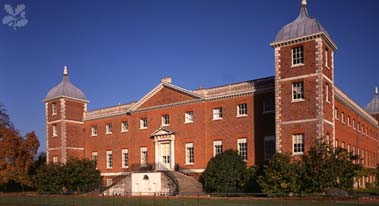
I was interested to find out more about the potential for using technology in a historic house context, particularly PDAs, and had heard some good reports of the hand held PDA tour at Osterley Park House. http://www.nationaltrust.org.uk/main/cymraeg/lo/w-vh/w-visits/w-findaplace/w-osterleypark.htm
Prior to our visit I met with Sian Harrington, Property Manager, and Robbie Frame of ATS http://www.ats-heritage.co.uk/news_osterley_park_1.phpwho worked on the guide. During our visit we met with Rhian Morris, Education officer. Its’ the first guide of its kind, and it was clear that staff were very enthusiastic and proud of what they’ve achieved (Rhian said she feels it is an example of something that has really worked) and that the guide, (and other interventions at Osterley) has gone down a storm with visitors, increasing visitor satisfaction ratings and numbers. There has been a downside, particularly with respect to the role of the volunteer guides and they didn’t all seem so keen, but on the whole, it is felt to have been a great success. Surprisingly many older visitors are choosing the guide, and many seem more excited by it than children.
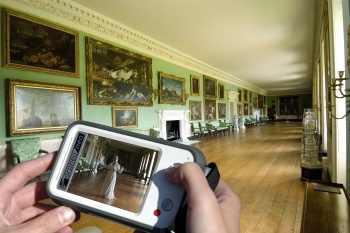
The guide has three different tour options: Family Explorer, Discovery and a signed version of the Discovery tour, which deaf visitors have been extermely positive towards. We tried out both of the main tours as we went round. I felt it definitely added to my enjoyment of my visit, but there were some definite strengths and weaknesses.
What I liked
- Actor/Character added life and personality to the house- was like getting a high quality character led tour
- Interactive elements like being able to open up doors, light candles, see inside the pedestals, see things close up, play the piano
- Embedded content- find out more about something you are really interested in
- Being able to see examples of what inspired artists and makers
- Like that you can choose to use the PDA or equally not to.
Cons:
- Made me look down at the guide more than at the rooms
- Content sometimes duplicated what you could see- why show me what the room looks like now?
- Was overly long (over an hour). But that said, most people seemed to be happy using it.
- Sometimes numbers weren’t on both tours- could be confusing
- Not sure that the discovery tour added much.
- Felt the style of tour was a bit prescriptive i.e. ask the guide about this if you want to know more?
- In general felt it was a step up from an audio guide but maybe a step too far. Less could be more…
- no foreign language provision- but arguably the visuals and interactivity would still add enjoyment and might work without translation. Could be subtitled or dubbed but not if character speaking.
There were some other really good interpretive ideas we took from the site including break out rooms on each floor on themes from the house. The most fun of these included a guess who game for kids with cartoons of key characters from below stairs, to match with the soft toy ‘tool’ they’d have used. This was simple and effective.
We were less convinced by the projections. Although they looked effective and added atmosphere to the servants quarters the slow moving projections with subtle sounsd of work (clinking of cutlery etc) gave a false impression of calm to what would have been a busy, noisy, bustling environment. Also this seemed out of place with the guide.
We also tried out PDAs at Tate Modern where we met with Nick Sherrard of Antenna and the Kew Ranger at Kew Gardens.
The Tate multimedia tour of Surrealism was a really useful contrast with the Osterley guide. It had to ask me to look at it, which I felt was the right way round. I was more inclined to look at the paintings and refer to the guide for extras like old photos of the artist in their studio. It made me realise that whether a PDA makes people look at or at the room is more about how content is scripted rather than by the fact of it including visuals. Why is it worse than looking down at a text guide. But equally, the additional cost would need to make it worth it over an audio tour/ text bat combination. A lot of the content was very audio led, but I felt more inclined to dip in and out of it than I did with the Osterley content which felt more linear and constraining.
The Kew Ranger was disappointing. Neither of us felt it was very user friendly. Although it was fitted up with GPS it didn’t really work to get us from A to B. I also felt I preferred not being cut off from the sounds of wind in the trees etc. I also felt the content could have been watched anywhere, and didn’t often add much to what was already there.
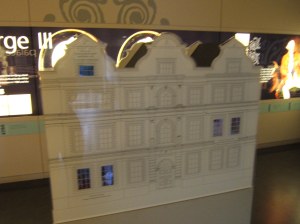
Kew Palace offers an alternative approach in the use of ambient Audio. We were met by Harvey Murray Smith, who told us about the project and some exciting new developments coming up including the reinterpretation of the georgian kitchens. The Kew redisplay, designed by Metaphor, takes a bold approach, using scripted drama fed through speakers in each room to tell the story of King George III and Queen Charlotte. It certainly breathes life into the rooms, although I felt it was a bit of a one size fits all approach, and I was aware that most people weren’t listening to the whole thing. I also worried about the implications for blind visitors.
Again visiting the property gave us a lot to think about, including some nice linking of inside and outside spaces through interpretation at windows, use of projection and a good introductory exhibition. There was also a very thorough DVD in the ‘people’s library’ or open study area giving snippets of video on a whole range of topics beyond the focused themes explored in the house.
In terms of what we will take from this for Culzean, I am not sure yet, but it was really useful to spend some time looking at and learning from what other sites have achieved, and it has certainly given us some ideas as well as as some parameters ain terms of what we would and wouldn’t want if we go down an AV route at Culzean.

